Once per line
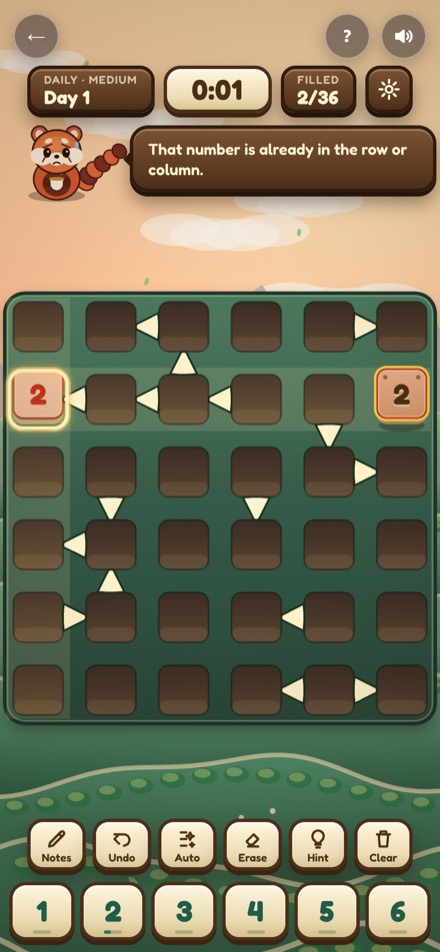
Every number from 1 to N appears exactly once in each row and each column.


Futoshiki is a number puzzle where less-than and greater-than signs guide you. Terrace Tea is a free Futoshiki you play in your browser: stones, slopes and a red panda, with no download and no sign-up, on a phone or a desktop.
Futoshiki is a Latin-square puzzle with inequality signs. You fill an N×N grid with the numbers 1 to N so that no number repeats in any row or column, and every sign between two neighbouring cells is true. The name is Japanese for “inequality”, which is also why it is called an inequality puzzle.
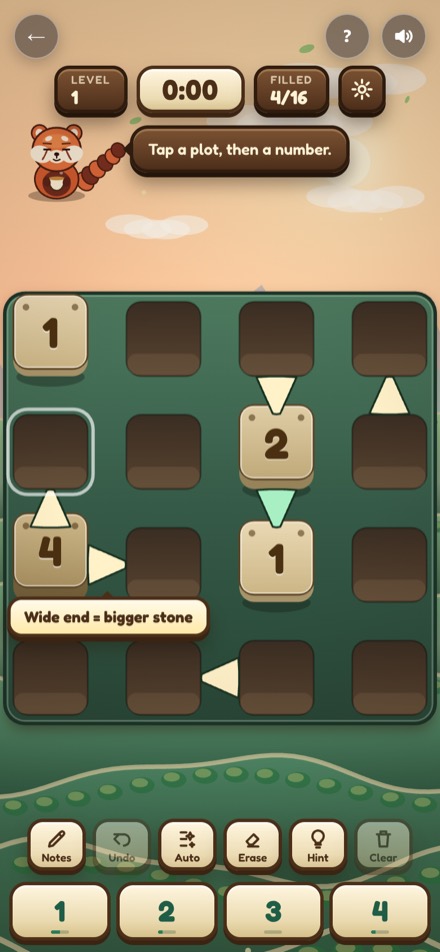
Terrace Tea is our own Futoshiki game. The grid is a hillside tea terrace: every number is the height of a stone, every sign is a slope wedge whose wide end sits on the bigger stone, and a row or column that comes out right bursts into tea flowers. Momo, a red panda, cheers you on and points out slips. Every terrace has exactly one solution, so there is always a single right answer to reason toward.
Every number from 1 to N appears exactly once in each row and each column.
A wedge points from the bigger stone to the smaller one. The wide end is the bigger number.
Stones that are already placed are locked. You cannot change them or write over them.
Begin on Level 1, a 4×4 terrace where Momo introduces the wedge as you play; the daily Easy 5×5 comes next.
Locked stones are given. Between some plots sits a slope wedge, and its wide end faces the bigger number.
Choose an empty plot and tap a number below. On a keyboard use 1 to 9, the arrow keys and Backspace to erase.
Notes writes small candidates in a plot. Auto fills every legal candidate for you, and by default placing a number wipes it from the notes in its row and column.
A finished row or column blooms. Fill the whole terrace correctly and you get your time and one to three tea cups.
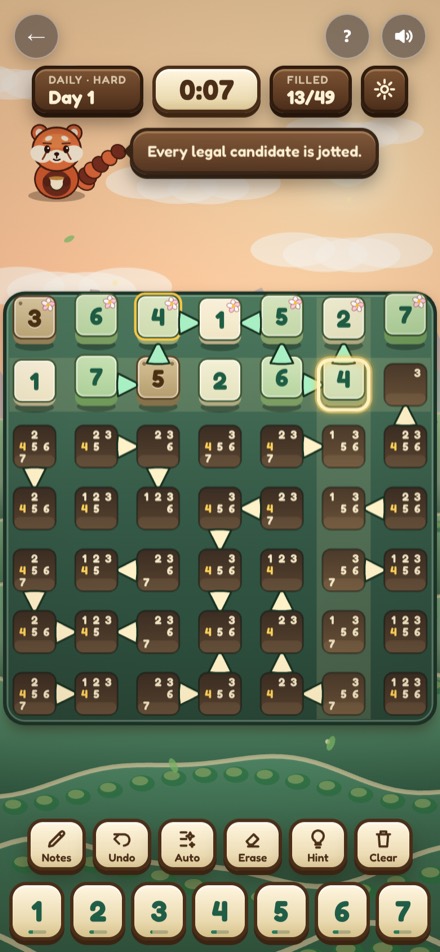
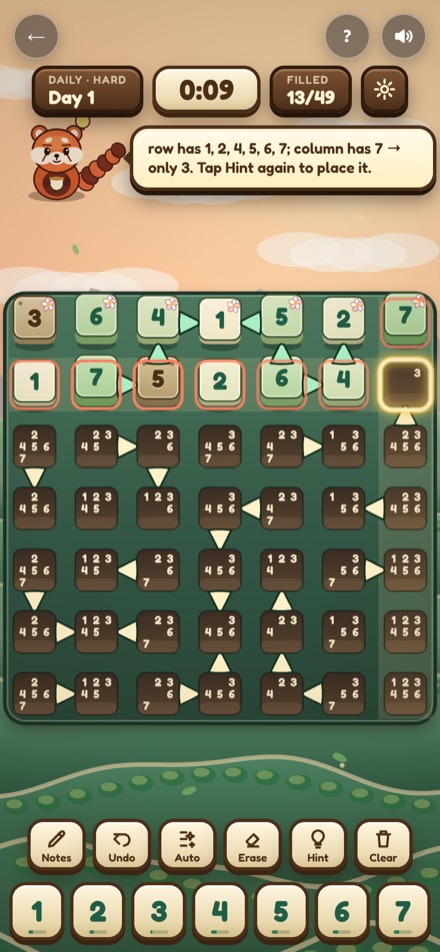
Most Futoshiki grids fall to four moves. Try them in turn, and loop back whenever a new stone lands.
When a row or column already holds every number but one, the last is forced. Notes make this easy to see: a plot with one candidate left must take it.
12?4→1234In a > b, the bigger side can never be 1 and the smaller side can never be the top number N. Rule those numbers out of the notes at once.
2–41–3A chain a < b < c squeezes the middle. In a 5×5 the middle can only be 2, 3 or 4, the small end 1 to 3 and the big end 3 to 5.
1–32–43–5If two plots in a line can only hold the same two numbers, those numbers cannot go anywhere else in that line. Strike them from the other plots.
2 32 32 3 5→5Out of moves? The hint button names the reason a number is forced, not only the number.
Terrace Tea posts a fresh daily Futoshiki every morning, identical for all players, in four terrace heights.
Want no calendar at all? The campaign is 60 levels climbing from 4×4 to 9×9. Stars and best times stay in your browser.
Terrace done for the day? Play Mossy has more daily puzzles to sip through next.
Futoshiki is Japanese for inequality. The puzzle is also called an unequal or inequality puzzle, because less-than and greater-than signs between cells do much of the work.
A sign points from the larger number to the smaller one. In Terrace Tea each sign is a slope wedge: its wide end touches the bigger stone and its narrow tip touches the smaller one.
Different, not necessarily harder. Futoshiki has no boxes and uses only the numbers 1 to N, but the signs link neighbouring cells, so you reason about ranges as much as single digits.
Level 1 of the campaign (4×4) or the daily Easy 5×5. Both are small enough to see every wedge at once, and Easy needs only singles and simple sign bounds.
Fill in notes with Auto, strike numbers a wedge rules out, look for pairs, then tap Hint. The first tap explains the reason; the second places the number.
Yes. There is nothing to download or sign up for, and it runs in a browser on phones, tablets and desktops.
Yes. Each one has a single solution, checked by a solver. The hardest may need a what-if step, which the hint explains.
In your browser's local storage on that device, so clearing site data or switching browsers starts fresh. Daily times use an anonymous cookie.
Usually you used no hints, but finished slower than par with mistake marks on. The third cup also needs a faster time or marks switched off.
No comments yet. Share a favourite wedge trick, or tell us which terrace gave you the most trouble.